

When new technology emerges, not everyone embraces it at the same pace. Some people are eager to experiment, others prefer to wait until the value is proven, and many fall somewhere in between. It’s a pattern so common that it has a name: the Diffusion of Innovations Theory.
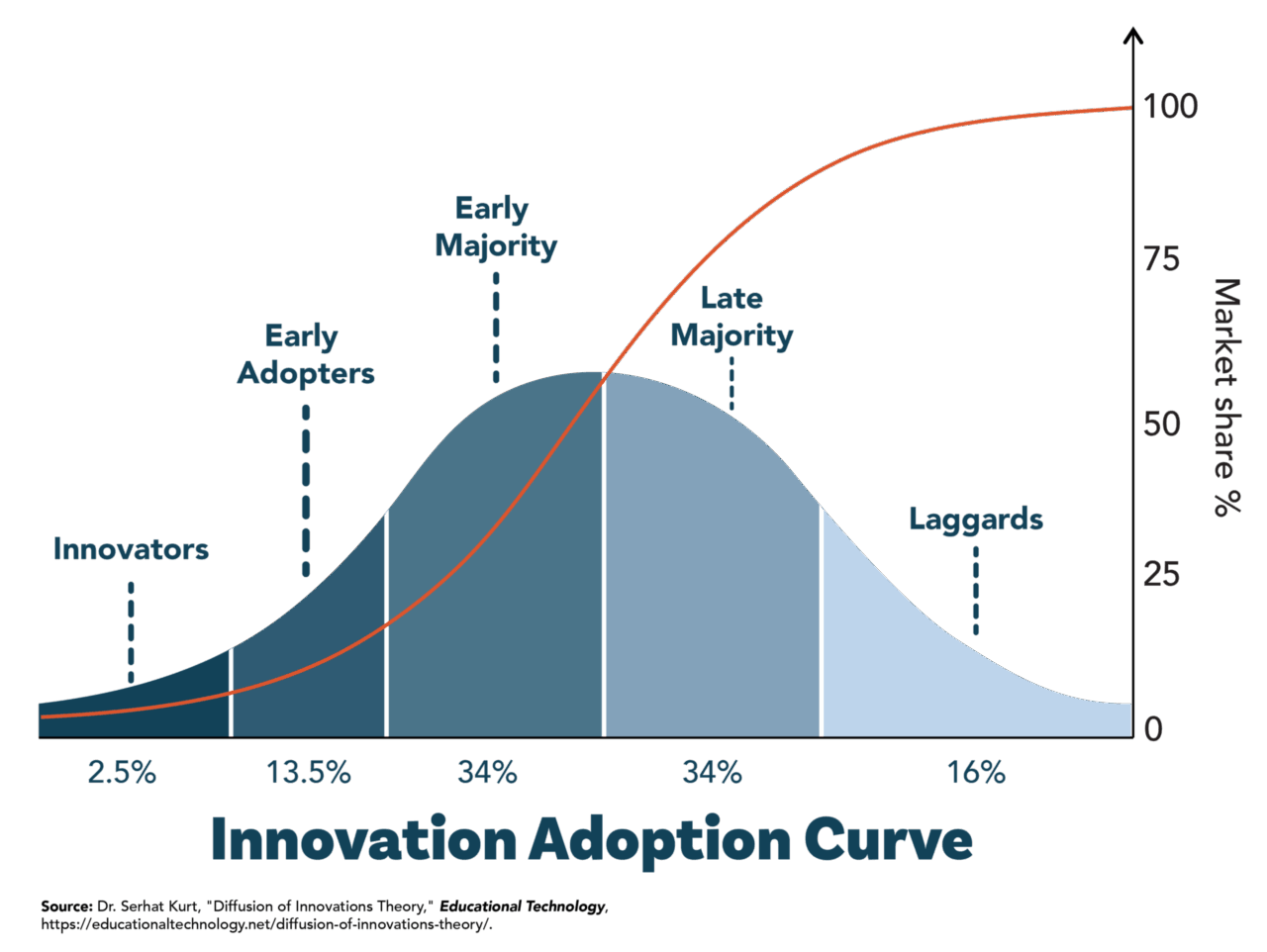
As Dr. Serhat Kurt explains: “Adopting new concepts, behaviors, or items … unfolds progressively, with some members being more inclined to accept the innovation sooner than others.”
We saw that same pattern in our recent research on AI adoption among farmers and ranchers. While some respondents have already made AI a regular part of their operations, others remain cautious.
In this blog, we’re taking a closer look at what separates the early adopters from the skeptics and how agribusinesses can learn from those differences as they develop AI-based solutions that farmers and ranchers will actually use.
Leaders: Big users are, well, big
Two of the most frequent users on the farm and ranch include dairy producers and large operations.
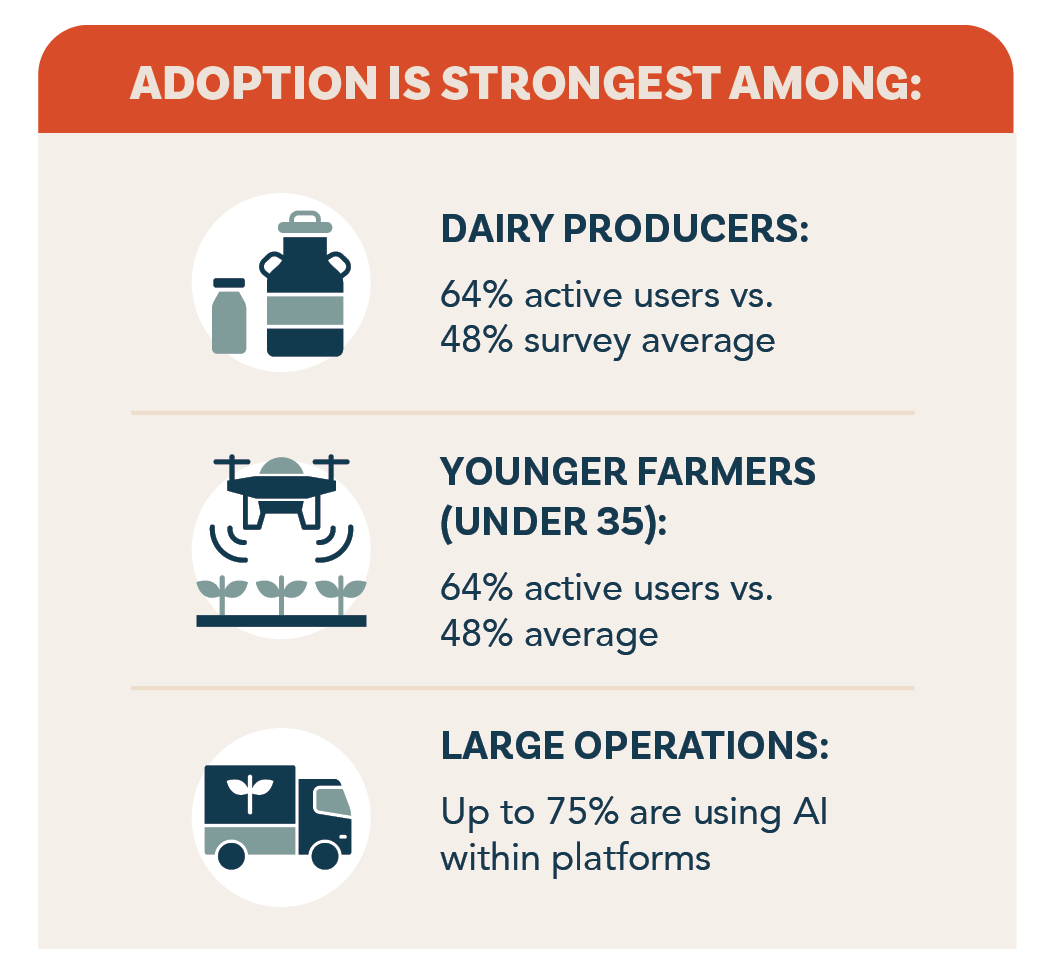
What do those two groups have in common? Scale.
According to USDA’s 2022 Census of Agriculture, dairy farms with 2,500 or more cows account for 45% of total milk sales. That concentration reflects decades of consolidation that have left the U.S. dairy industry with fewer dairies and larger, more efficient farms.
USDA’s Economic Research Service (ERS) reports this shift coincided with dairy farms’ increased use of advanced technologies and management practices like more frequent milking, computerized feeding systems and automated milking systems. ERS also points out that some of these technologies may be “scale-dependent” and “better suited to larger farms.”
These larger dairy operations have also leaned into technological advances and new management ideas in the past and have experienced the very real gains in profitability they can bring.
Consequently, the transition to AI tools is more of a natural next step for the dairy industry.
Scale creates both data and bandwidth
Another factor that shouldn’t be understated is the difference in bandwidth at large operations. Scale doesn’t just create more data; it also creates more complexity, more digitization and, often, more resources to manage both.
Dairy operations illustrate this well. The business of milking cows generates an enormous stream of data each day. AI’s ability to process and surface insights from those datasets are especially valuable in an industry driven by economies of scale.
That data intensity may also help explain why livestock producers are more frequent users of AI technology than their row-crop counterparts.
Similar dynamics are at play with large operations more broadly. A vertically integrated dairy or large-scale row-crop operation may have far more data to manage, but they also tend to have the staff capacity to vet AI tools and determine where they can deliver value. Smaller operations, by contrast, may lack the time or personnel for testing and implementation.
Purdue University’s Large Commercial Producers Survey reinforces this pattern, finding that large operations tend to be more analytical and data-driven in their decision-making, though lived experience, pattern recognition and intuition remain important components.
Laggards have different workflows and resources
And that brings us to our laggard on the farm and ranch front: row-crop producers.
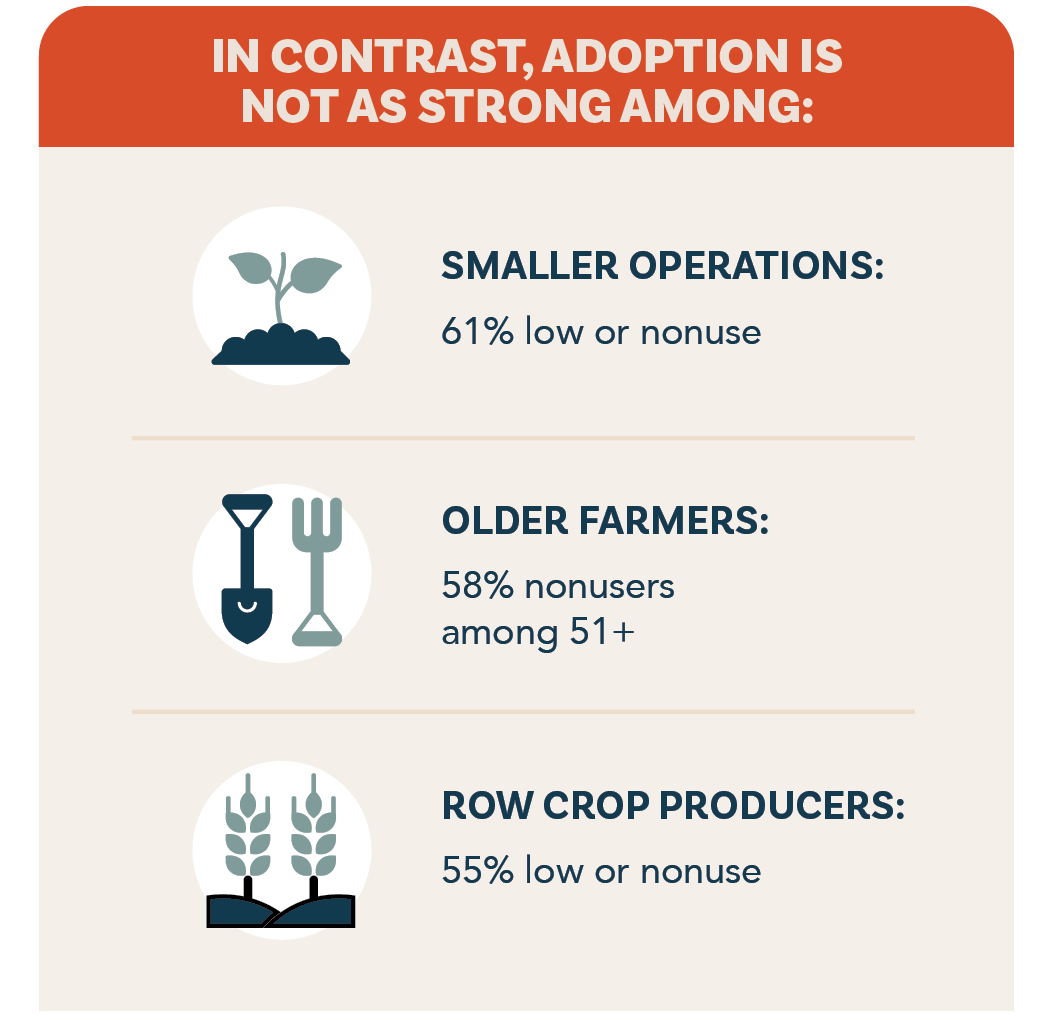
This group reported 27% non-use and 28% infrequent use (less than weekly), but it’s difficult to know whether the latter figure signals low adoption or simply the ebb and flow of their work patterns.
Make no mistake, the production of corn, soybeans and other crops is also data-intensive. But the flow is more seasonal and the volume is less than that at large operations. That, alone, may explain why row-crop producers use AI less frequently than dairy or livestock producers.
Small and medium-sized operations also have less bandwidth to take on new technology. For an individual row-crop producer handling everything from growing and marketing his crop, making time to figure out where AI fits and how to use it is an enormous undertaking in and of itself.
Adam Gittins, a farmer and president of HTS Ag, a company providing high-tech solutions for agriculture, shares that his customer base runs the gamut — from those who have never touched AI to those using an array of AI tools each day.
“It’s such a broad audience. Some farmers are very anti-AI, some are all for it and then there’s pretty much every flavor in between,” he says.
Age matters
Surprising absolutely no one, our results also showed age played some role in farm and ranchers’ AI use, though the differences were not as extreme as you might expect.
The breakdown in non-use is as follows:
- Age 19-35: 29%
- Age 36-50: 15%
- Age 51+: 29%
On the other end of the spectrum, the number of farmers and ranchers using AI weekly or more breaks down as follows:
- Age 19-35: 64%
- Age 36-50: 55%
- Age 51+: 41%
A separate American Farm Bureau survey of Young Farmers & Ranchers during an AI workshop showed 43% used AI often versus 10% who never use AI tools. The remaining 47% use AI occasionally.
While comfort with technology certainly comes into play, Purdue University’s Large Commercial Producers Survey signaled age may be less of a factor than many assume. While there’s a tendency to think younger producers are inherently more data-driven, Purdue’s data signals training, exposure and system complexity may have a bigger impact on decision-making than age.
Ag retailers are reluctant
But the group that had the lowest numbers on AI use, trust, and value was ag retailers. Knowing that group of professionals often plays an important role shepherding in and giving credence to new technology, this was one of the biggest surprises of our study.
And it’s a dynamic we plan on covering in more detail next month. Stay tuned.
The capabilities of AI-driven tools also come into play
Another element impacting farm use is the tools themselves. It’s no secret that these tools are far from perfect, struggling with certain tasks like advanced math or distinguishing between old and new information, hallucinating and sometimes telling users what they want to hear rather than what they need to hear. Plus, there are an array of data security and ownership concerns.
As a result, farmers’ and ranchers’ trust in artificial intelligence recommendations is low.
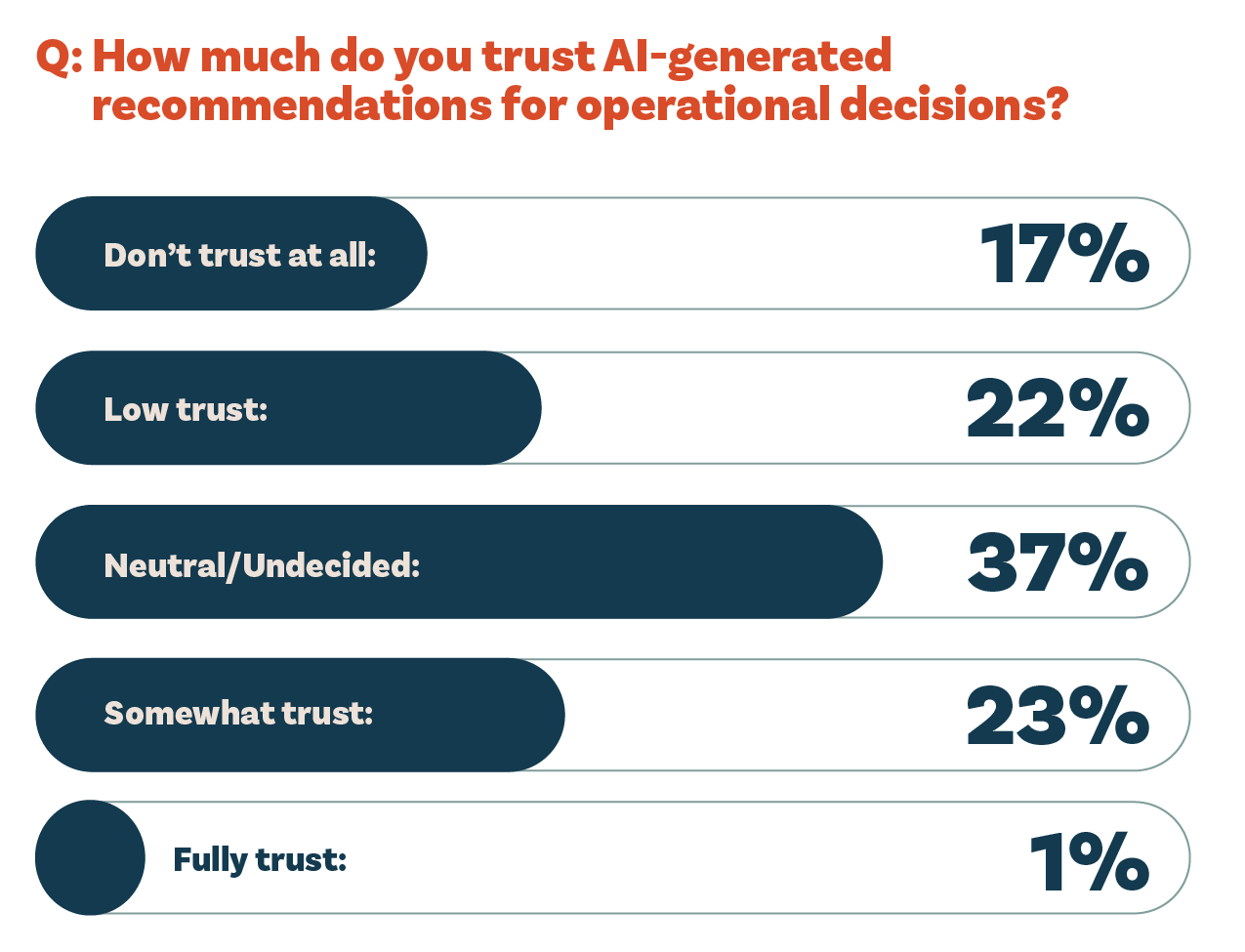
They have concerns about the accuracy of AI’s information, data privacy/ownership, and bias or brand-influence coloring recommendations. For those with limited time to “learn” or experiment with these tools, those roadblocks can be significant deterrents.
“I think we are early in the adoption of AI and I don’t know that there’s been those huge leaps in the tools yet that generate significant value yet,” Gittins says. “Until people see that breakthrough, adoption won’t rise much. But as fast as AI is changing, I think that could happen soon.”
Investing in better AI tools made a big difference at one dairy, who notes that a bad experience with some of the less powerful AI tools can turn people off to the technology altogether.
On the other hand, when AI delivers a workflow win, it’s often a lightbulb moment. Seeing continuous model improvement resulting in easier connections, more capabilities, better answers, and fewer errors helps build trust in these tools.
One of the AI-powered tools HTS Ag uses is drone imagery. “We capture images of a field and stitch them together to create a high-resolution map. We can use AI to count every corn plant in that field, we can use the maps to understand weed infestations, gauge disease pressure or locate drowned-out spots,” Gittins explains. “When we’re able to show that in action and train farmers on it, they’re much more likely to latch on to those AI based tools.”
Showing farmers and ranchers real-world farm results will be critical to any buy-in. Sixty-two percent of them indicated real-world farm results would boost their trust in AI, more than double the next highest option (ability to override or audit recommendations).
Build AI solutions to fit the farm
For agribusinesses developing AI tools, the takeaway is clear: Know your audience and design for the realities of their operations.
What delivers value for a large dairy managing continuous streams of data may not fit the workflow or limited bandwidth of a smaller row-crop farm. The most effective solutions will be accurate, easy to integrate and supported by real-world farm results—not theoretical capabilities.
The differences between agriculture’s AI leaders and laggards are less about openness to innovation and more about whether AI farm technology offers value and a clear, credible fit.
Find more study results—and strategies for turning those insights into action—in MorganMyers AI & Agriculture Report.