
What Are Best Practices for GEO?

What Are Best Practices for GEO?
It’s happened – your leadership team sent out a memo that all future projects need to be AI-ready. Or a survey of your top customers came back and it turns out they all use Perplexity to compare products before buying. In both cases, you’re now part of an industry wide move towards making your content important in the eyes of AI, and likely part of the 62% of marketers with little to no training in GEO or generative engine optimization.
Luckily there are immediate steps you can take to start moving your public facing digital content towards AI readiness, all without losing your company voice and the parts of your brand that your audience is looking for. Use this guide as a resource in ways to implement AI readable content and position your brand for long-term success in this next generation of digital experience.
Reportable Metrics
All GEO work needs to start by establishing clear, replicable metrics that can guide and inform content decisions. As we covered in our last blog, AI search is incredibly personalized. It’s also largely sourced from companies without existing reporting tools, which makes it difficult to track results over time. We work to overcome these two challenges by implementing easy to follow metrics that answer key AI questions, are directional even in the face of personalization, and can be easily pulled in each of our client reports.
| Metric | Purpose |
| Estimated AI Overview Visibility | Similar to a share of voice or visibility score, this metric helps you understand how often your brand or products are referenced in common AI search queries. |
| AI Search Query Sentiment | A percentage calculation of whether the AI searches commonly associated with your website are positive, negative or neutral. |
| AIO Clicks | Measures how many times a person clicked to your website based on an AI snippet. |
| AIO Impressions | Measures how often your website content was featured in an AI overview result. |
| AIO Snippets | A qualitative metric showing the most common beginning snippet generated by an AI search tool. |
Answer-First Structure
Copywriting and social media teams are continually drafting content in ways that ensure audiences can easily grasp a brands message, tone and goal. Now that content has two audiences – the humans whose purchases and decisions we want to have with our brands, and the AI tools they now rely on to synthesize information, compare products and understand company history. An answer-first structure reaches both at once by refocusing content away from short, enticing outlines designed to drive deeper in the funnel engagement and more towards long form pieces that lead with a brief answer, and expand on it later on. This approach satisfies fast moving humans looking to get answers as quickly as possible, but it also aligns directly with how AI search tools parse and convey information – finding the correct response, then augmenting it with extra context to create a rich, yet readable response.
While there are many ways to move towards answer-first content in your content, the following approach is a great place to start. Look at incorporating these tips the next time you draft a campaign landing page or dedicated product hub.
- Provide a brief summary
- Answer common questions with an overview of your content.
- Expand on your answer in later paragraphs of your blog or article, helping the AI search tool provide context in the event a user asks a follow up question.
- Use definitions, tables and bullet points
- Define any complicated or niche-specific terms early on so that AI tools can accurately understand what is being discussed.
- Utilize tables and bullet points to define relationships between entities (think pet food, soybean cyst nematode, marketing, etc) and the key points in your content.
- Incorporate common conversational queries
- Make sure you have a list of conversational or long-tail queries commonly used by your audience, then use the list throughout your post copy.
- Consider any follow-up questions your audience might ask an AI search tool, then update your content to provide answers to those questions.
- Build out knowledge-focused website sections
- AI search tools love concise sources of knowledge such as FAQ’s, Q&A blocks, reports or testimonials.
- Provide answers to common queries directly, while also incorporating SEO best practices to capture traditional search results as well.
User Experience
Optimizing for AI search is the future of marketing, but it’s only one piece of the puzzle. It’s important to provide content not just for an answer-first top of the funnel awareness, but also for those in your audience who want to take the next step. You want AI to be able to read your website and convey your messaging back to your audience, and you want your audience to come to your website for those features AI can’t replicate. Think website features and experiences like contact forms, in depth supporting resources, movable 3D product examples and interactive elements such as calculators.
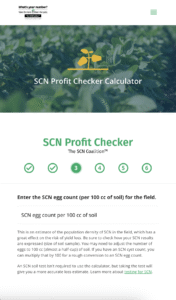
We’ve deployed examples in the past that provide direct value to a key client audience – farmers trying to understand the impact of a pest on their crops. While ChatGPT and other search platforms can provide some advice on how to manage the pest, they can’t replicate the SCN Coalition Profit Checker Calculator, a proprietary tool trained on university led research. Farmers input a few key numbers, and get an estimate of total impact. AI could try to replicate it, but the combination of well trusted results and an easy to use interactive web page gives a valuable user experience not easily found elsewhere.
Profit Checker Website
Think about what your brand has to offer that AI can’t easily replicate. Do you have large research PDF’s that are bigger than an AI context window? Feature them in an interactive experience that researchers can easily swipe to. Does your product have full screen, highly visual renders so buyers get an idea of the scale? Make sure they’re presented in a visually appealing structure, and offer tools such as zooming in or panning so users can get a non-replicable experience
Implementing these best practices will have you well on your way to riding the AI wave. From well-defined tables to interactive apps, providing distinct, clear and valuable content is just as valuable as it’s always been, but with a few key recommendations to make your work appealing to human and AI eyes alike. If you’d like help in your GEO journey, reach out to our team today.
 Back To Blog