
4 Surprising Things We Learned About AI for Agriculture

4 Surprising Things We Learned About AI for Agriculture
As a marketing and PR firm steeped in agriculture, we wanted a clearer read on how farmers, ranchers and agriculture retailers are using artificial intelligence. So we surveyed them, collecting insights on adoption and attitudes toward AI for agriculture.
Some of the findings lined up with our expectations. Others did not. Today, we’ll dig into four things that surprised us.
1. The ag retailer bottleneck
Perhaps the biggest surprise was that agriculture retailers lagged farmers in pretty much everything when it came to AI.
- 63% of the ag retailers rarely or never use AI at work.
- 60% of ag retailers gave AI low marks on trust.
- 34% of ag retailers say AI has not been useful to their business.
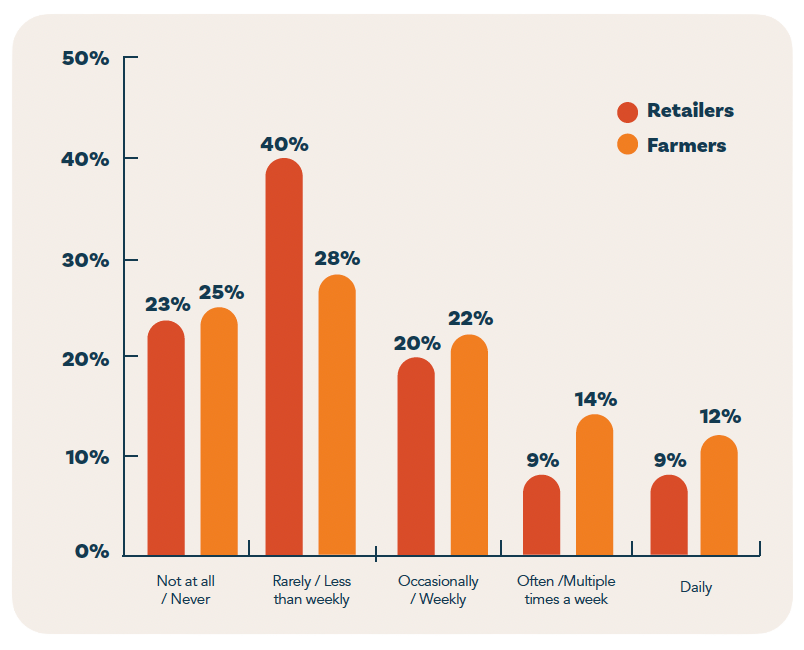
We included this group in our survey for a reason. Ag retailers have traditionally helped build confidence in new technologies. Research from USDA’s Economic Research Service, CropLife/Purdue University and others shows farmers and ranchers rely on those trusted advisors to vet and build confidence in emerging precision and technological tools. Farmers turn to them with questions like “How can AI improve pest detection?” or “How do AI systems improve crop yield predictions?”
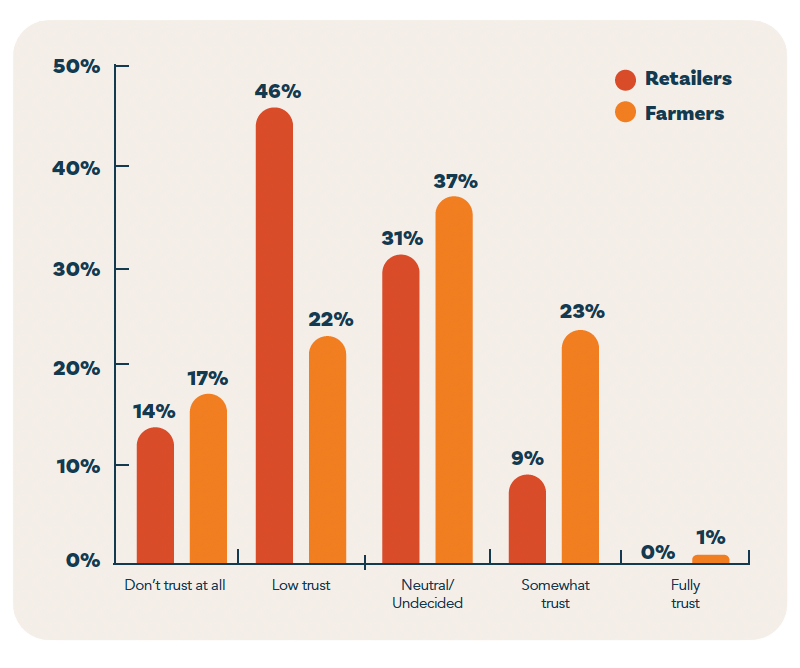
But our survey showed ag retailers trail farmers in AI adoption, value and trust. Why might that be?
- At this point, retailers may have less to gain financially from using AI than a farmer or rancher.
- There’s also the sense that some of these AI technological solutions are vying for these retailers’ role as trusted advisors.
- Our survey also signaled retailers are concerned about producers’ ability to use these tools, with 66% of ag retailers expressing concern about customer confusion or misuse.
Ag retailers know farmers value their opinion, so they’re unlikely to endorse AI tools they don’t fully understand, trust or see value in. And at this point, many do not.
For now, ag retailers are more likely to slow than to advance AI adoption in agriculture.
2. Three out of four producers have tried AI
While we didn’t expect AI use among farmers and ranchers to be low, we also didn’t expect their total workplace use to surpass that of the general workforce. Our survey showed 75% of farmers have tried using AI to support their operation. A Gallup poll from the same period showed 50% of the broader workforce has used AI on the job.
But maybe we should have expected high use. Farmers and ranchers operate in a business where weather, biology and global markets can shape profitability as much as any management decisions. The stakes of experimentation are high. Tools that boost efficiency, make sense of mountains of data, and enhance decision-making have obvious appeal. The market for AI in agriculture is projected to reach $4.7 billion dollars by 2028, according to Forbes.
It’s also worth noting that many of today’s family farms are multi-generational. While the average farmer age is near 60, many operators work alongside younger farmers and ranchers more comfortable with AI technology.
3. Dairy and AI go way back
Dairy is one of the biggest users and believers in AI. Our survey showed 69% of dairy producers use AI features within ag platforms at least weekly, and 64% use general AI tools like ChatGPT or Gemini regularly. They also have more trust in AI than beef, swine or row-crop producers.
And they’re finding it worthwhile. Our survey showed 96% of the dairy producers say these tools have delivered some level of value to their operation, with over half of them describing these tools as very or extremely valuable.
Driven by consolidation, labor shortages and the 24/7 demands of the business, the dairy sector embraced automation and AI-powered tools years ago. Technologies like activity monitors and robotic milkers have long been part of dairy operations, making today’s AI advances feel more like a natural evolution than a dramatic shift.
This sector is also rich in data, and the ROI of changes prompted by AI is easier to quantify and quicker to see compared with other sectors.
For instance, an AI-powered health monitoring system may detect mastitis faster, helping dairy producers curb treatment costs and limit lost milk production. A row-crop producer, meanwhile, may use AI to optimize nitrogen applications. But because yield is influenced by so many factors, it can be difficult to quantify whether that paid off.
4. Accuracy concerns signal AI technology has some work to do
Wrapping up our roundup of surprises from our AI in Agriculture Survey is how high accuracy of recommendations ranked in terms of their trust in AI. Cited by 72% of the farmers and ranchers we surveyed, this came in well ahead of concerns about data privacy and ownership (57%) or biased or brand-influenced recommendations (51%).
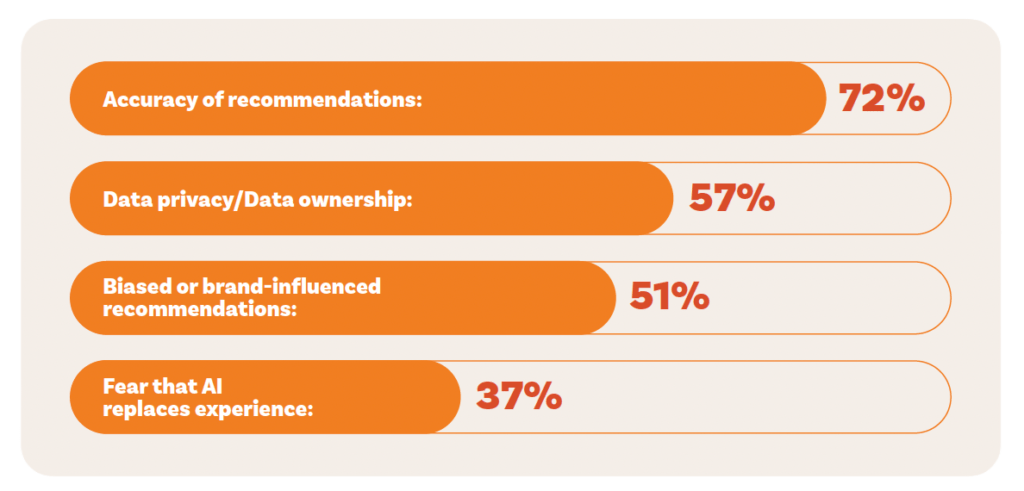
Given that most farmers have used AI and half of them are using it regularly, their outsized concerns about the accuracy of recommendations appear to stem from experience rather than abstract skepticism.
So far, farm applications for AI have largely centered on administrative and planning side of things, with producers using tools like ChatGPT draft emails, compare products or fine-tune livestock nutrition.
Before taking bigger steps, farmers want to see AI tools proven on farms like their own. They want validation from advisors and peers. They’re looking for answers to questions like “What are the benefits of machine learning for diseases detection on your farm?” And most still want to have the final say, with AI as a decision-support tool.
Data-driven decision making will remain balanced by lived experience and pattern recognition.
Ready to learn more about AI’s role in agriculture?
Take a closer look at the full survey results and insights into how organizations developing AI-powered solutions for agriculture can apply these findings.
Download the full report or reach out — we’re happy to talk shop.
 Back To Blog