
What’s Holding Agricultural Retailers Back on AI Adoption?

What’s Holding Agricultural Retailers Back on AI Adoption?
Ag retailers have long played a critical role in farm adoption of new technology, serving as a bridge, proof point and support resource for farmers evaluating new tools. That’s why their responses to MorganMyers’ survey on artificial intelligence use and attitudes caught us by surprise.
To put it bluntly, agricultural retailers are dragging their feet on AI — lagging their farm and ranch customers on AI adoption, value and trust.
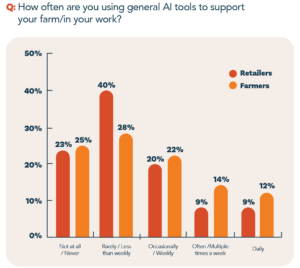
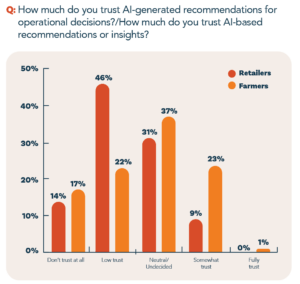
Why are agricultural retailers dragging their feet?
“I think there’s a segment of ag retailers who are afraid AI is going to replace them,” says Adam Gittins, a farmer and president of HTS Ag, an agricultural retailer providing farmers precision ag solutions.
But Gittins believes the opposite is true. “I think AI will enhance what ag retailers are capable of and give them the ability to have a broader reach and deeper knowledge, whether that’s new details, different data sets or pattern analysis.”
The quality of AI results appears to be another holdup. MorganMyers’ survey results, Gittins’ perspective and conversations with others in the industry all point to the same concern: AI has potential, but its execution and output of tools like ChatGPT still leave something to be desired for agriculture.
Better results needed for buy-in
When asked whether AI has been useful in helping them support customers or run their businesses, 34% of agricultural retailers said the technology was “not at all useful,” while another 43% described the benefit as “slight.”
Their top concerns about the use of artificial intelligence in farming include:
- Accuracy of insights (80%)
- Customer confusion or misuse (66%)
- Data privacy or data ownership (63%)
And while AI may ultimately prove to be a time saver, there is an additive nature to it, especially out of the gate. Retailers may feel this doubly so — learning something themselves and also helping farmers to navigate AI tools.
“We’re all creatures of habit, and bringing these technologies to the farmer takes more effort,” Brendan Bachman, director of FS Agronomy for GROWMARK, observed during a panel discussion at the 2026 Tech Hub Live Conference.
Once AI-driven tools prove they are worth agricultural retailers’ time — whether through financial return, stronger customer service, better inventory management or more accessible supply chain optimization — adoption at the ag retail level is likely to increase.
Agricultural retailers’ top ask: Better predictions and recommendations
Ag retailers’ top asks of AI when it comes to better supporting their customers or business include:
- More accurate predictions or recommendations (71%)
- Faster data analysis (51%)
- Forecasting demand or inventory (51%)
It’s worth noting one of the possible responses was “help make faster recommendations.” The fact that accuracy pulled in more than double the response that speed did adds to our suspicion that subpar AI results have been a deterrent.
What’s at stake?
Another factor holding back ag retailer adoption of AI-powered tools is reputational risk. Agricultural retailers are part of farmers’ support teams, acting as sounding boards, sources of advice and experts in their respective areas. With that role comes the trust and influence of a true business relationship.
We asked retailers: “How much influence do you believe your recommendation has on whether farmers trust AI-enabled tools?” Their response:
- 17% no influence
- 31% slight influence
- 23% moderate influence
- 26% high influence
- 3% major influence
With 83% of retailers signaling they think they have some level of influence on farmers’ trust of AI tools (more on that later), they are unlikely to put their reputation on the line via an endorsement unless they are pretty darn confident in said tool’s ability to deliver.
As Warren Buffett famously said, “it takes 20 years to build a reputation and five minutes to ruin it.” (Find more top 10 life lessons from the Oracle of Omaha.)
Retailers are understandably proceeding with caution with these rapidly evolving tools. Sixty percent of the retailers we surveyed indicated they were unlikely or slightly likely to recommend AI-driven tools to customers more often over the next 12 to 24 months.
What will build retailers’ confidence in AI tools?
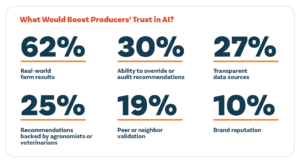
For farmers and ranchers, the clearest trust builders were real world farm results, the ability to override results and transparency. Those same factors likely matter to retailers, too — perhaps even more so since they will be putting their credibility behind any AI-supported recommendations or endorsements of AI-driven tools.
“I think there are a few ag retailers who will make waves using AI, and once that happens and other ag retailers see the value of what they can do, adoption will accelerate,” Gittins predicts.
His company is one of the trailblazers, actively working to harness the opportunity it presents. He’s using AI to draft blogs, compile presentations, and improve communication with customers. But HTS Ag is also working to bring cutting edge AI-powered tools to customers, such as his work with farm drone imagery and AI-powered crop monitoring.
How one ag retailer uses AI to enhance precision ag service
“Once a drone captures field imagery, we can stitch those images together to create a high-resolution map,” Gittins explains. “From there we can use AI to count every plant and determine the entire field’s stand count. We can identify weed pressure and look for disease. We can pinpoint drowned out spots.”
Gittins’ work behind the scenes using AI for research has also proven worthwhile. Drone regulations are ever-changing, especially for spray drones, he explains. AI has helped him pull together extensive research on spray drones from every U.S. university and compile a research paper. From there, he was able to boil it down to the most pertinent and valuable information that could be presented to farmer customers, showing them how drones work best.
“Research shows that when you fly higher and faster, the drone’s pattern doesn’t hold up as well so coverage isn’t as good,” Gittins shares. “For the best results spraying with a drone, I need to fly at or below 10 feet above the crop canopy and less than 15 miles per hour, which isn’t common practice.”
What’s at stake for agricultural retailers?
Gittins and his team try to stay sharp by attending conferences, subscribing to newsletters on the topic and staying abreast of the latest developments.
“But I think my biggest piece of advice is don’t be afraid to try it,” he says, adding he finds it helpful to think of AI as the starting point, not the final destination and to always remember “you’re the adult in the relationship.”
Treading with caution is one thing, but a complete avoidance of the technology that farmers and ranchers are in fact using with some regularity could have some real consequences for agricultural retailers.
“I think producers and retailers not figuring out how to use these tools are making a big mistake,” Bachman said during the panel discussion. “There are so many opportunities for those of us who understand the data we have at our fingertips now.” He believes those who wait a few years to adopt these rapidly developing tools may not be able to catch up.
Many are vying for farmers’ attention
Of note, Purdue University’s 2025 Large Commercial Producer Survey and a companion survey revealed a perception gap when it comes to ag retailers’ influence. Purdue’s Masie Keshavarz and Erin Robinson explain:
“When asked to identify the single most important source of new ideas, 25.2% of retailers believed dealer or retailer representatives, publications, newsletters, advertisements, or websites were farmers’ top source. But only 13.6% of farmers actually ranked dealer or retailer sources first. That’s nearly a 12-point perception gap. Instead, producers ranked ag media first (25.6%), followed closely by other farmers (21.0%).”
The takeaway isn’t that agriculture retailers lack influence. It’s that their influence is increasingly shared among a wider range of sources.
As that information landscape becomes more crowded, ag retailers can evaluate the value they’re providing — and how that value stacks up against other influences, from university newsletters and ag media to peer networks and competing dealers.
From cautious to competitive advantage
The retailers who gain confidence with AI now may be better positioned to protect their advisory role as farmers evaluate new tools, new information sources and new decision-making support.
Want a deeper look at how farmers, ranchers and ag retailers view AI? Download the 2026 MorganMyers’ AI & Agriculture Report for the full findings and implications for agribusiness leaders.
 Back To Blog